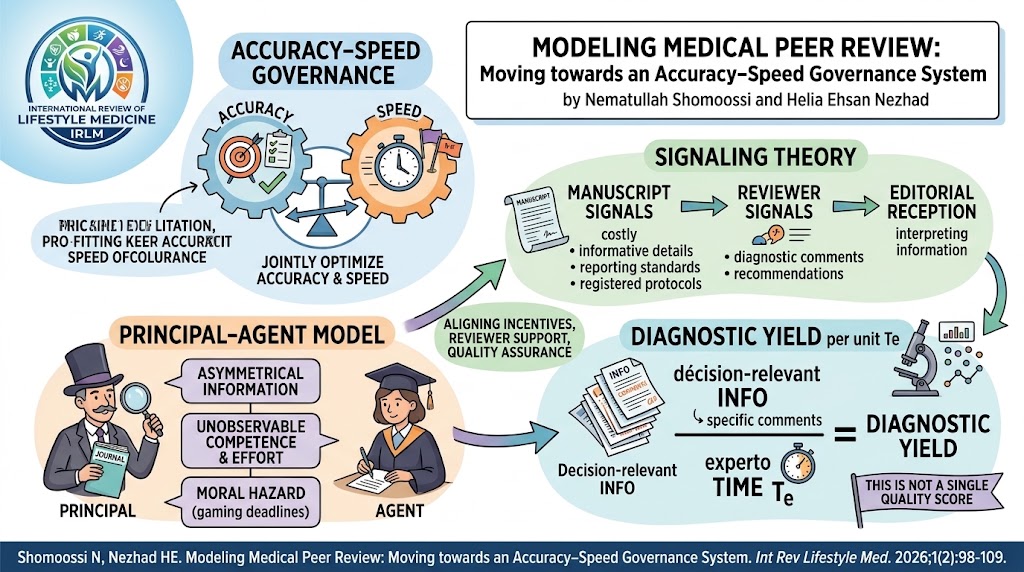
Background and Objective: Peer review is commonly described as quality control, but this description is incomplete. In medical publishing, editorial systems often measure review speed directly while inferring accuracy indirectly, creating an asymmetry that rewards visible promptness even when the diagnostic value of reviews is weak. This article is written to suggest a governance model that reframes peer review performance around “diagnostic yield per unit time” rather than speed alone, and to translate this construct into a practical editorial architecture. Methods: This narrative review draws on signaling theory, principal–agent theory, and incentive design to model the exchanges of imperfect signals among authors, reviewers, editors, and journals. Results: The article proposes an editorial architecture built on five linked functions: (1) transparent manuscript signals; (2) competence-sensitive reviewer matching; (3) coverage-based review prompts; (4) lightweight quality assurance; and (5) recognition tied to useful diagnosis rather than mere completion. The model preserves reviewer independence by distinguishing governance of the review process from control of substantive judgment, and it addresses conflicts of interest, language-related inequity, open peer review, reviewer training, and the role of artificial intelligence. Conclusion: The proposed system offers a testable framework for improving accuracy, timeliness, fairness, and sustainability in medical peer review without reducing it to a mechanical score.
Shomoossi, N. & Ehsan Nezhad, H. (2026). Modeling Medical Peer Review: Moving Towards an Accuracy–Speed Governance System. International Review of Lifestyle Medicine, 1(2), 98–109. https://doi.org/10.22034/irlm.2026.604298.1021
MLA
Shomoossi, N., & Ehsan Nezhad, H. "Modeling Medical Peer Review: Moving Towards an Accuracy–Speed Governance System", International Review of Lifestyle Medicine, 1, 2, 2026, 98–109. doi: 10.22034/irlm.2026.604298.1021
HARVARD
Shomoossi, N., & Ehsan Nezhad, H. (2026). 'Modeling Medical Peer Review: Moving Towards an Accuracy–Speed Governance System', International Review of Lifestyle Medicine, 1(2), pp. 98–109. doi: 10.22034/irlm.2026.604298.1021
CHICAGO
Shomoossi, N. & Ehsan Nezhad, H., "Modeling Medical Peer Review: Moving Towards an Accuracy–Speed Governance System." International Review of Lifestyle Medicine, 1 2 (2026): 98–109, doi: 10.22034/irlm.2026.604298.1021
VANCOUVER
Shomoossi N., Ehsan Nezhad H. Modeling Medical Peer Review: Moving Towards an Accuracy–Speed Governance System. Int Rev Lifestyle Med. 2026;1(2):98–109. doi: 10.22034/irlm.2026.604298.1021
 International Review of Lifestyle Medicine