A Critical Review of Multi-Targeted Non-Invasive Gamma Neuromodulation for Alzheimer’s Disease: Harnessing Neural Network Dynamics in Lifestyle Medicine

Document Type : Narrative review

Authors
1 Yahyanejad Hospital, Department of Psychiatry, Babol University of Medical Sciences, Babol, Iran
2 IKIU, Qazvin, Iran
Abstract
Background and Objective: Alzheimer’s disease (AD) is a growing global health burden characterized by amyloid-beta plaques, tau neurofibrillary tangles, synaptic loss, and cerebral atrophy. Although anti-amyloid monoclonal antibodies enable plaque clearance, their modest cognitive benefits, safety concerns and high costs limit utility. Safe, scalable non-pharmacological interventions targeting network-level pathology are urgently needed. This review critically examines AD’s multifactorial progression, limitations of current therapies, and emerging evidence for non-invasive 40 Hz gamma neuromodulation, Gamma Entrainment Using Sensory stimuli (GENUS), as a multi-target lifestyle intervention.
Methods: We synthesized data from clinical trials, observational cohorts and preclinical experimental models. Analyses included longitudinal 40 Hz sensory stimulation protocols, sleep actigraphy, fluid biomarkers, and preclinical studies elucidating glymphatic clearance and neuron–microglia interactions.
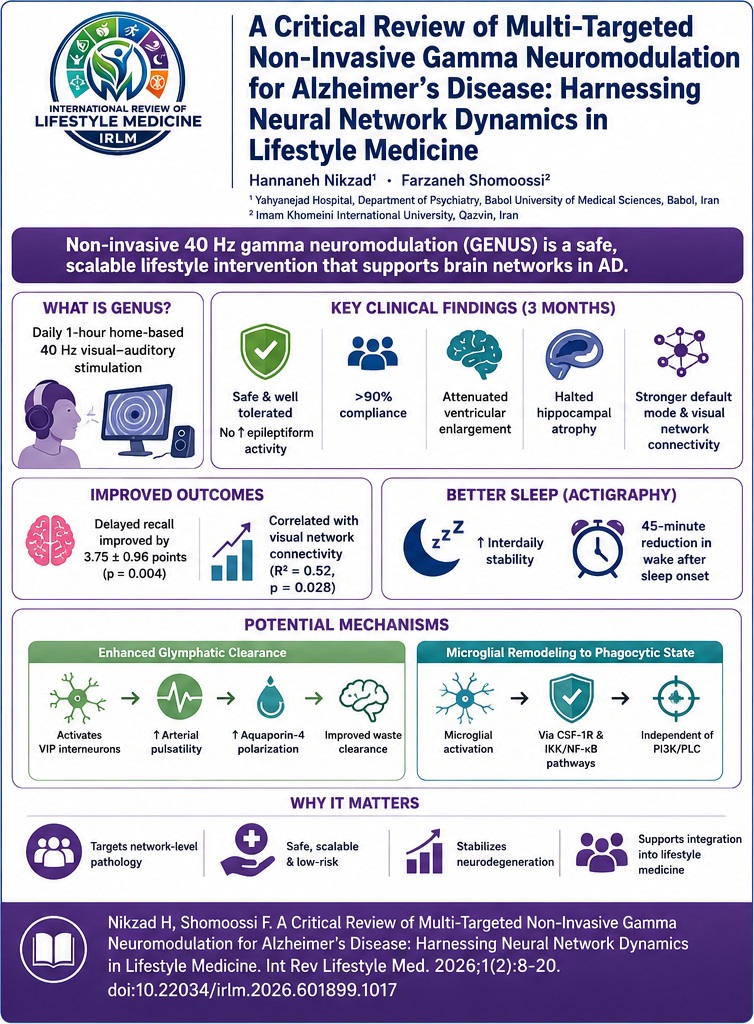
Results: Daily 1-hour home-based 40 Hz visual–auditory stimulation was safe, was not associated with increased epileptiform activity, and achieved >90% compliance. At 3 months, GENUS attenuated ventricular enlargement, halted hippocampal atrophy, and strengthened default mode and visual network connectivity. Actigraphy showed improved sleep consolidation (higher interdaily stability; 45-minute reduction in wake after sleep onset). Delayed recall improved significantly (3.75 ± 0.96 points; p=0.004) and correlated with visual network connectivity (R²=0.52; p=0.028). Mechanistically, GENUS enhanced glymphatic clearance via vasoactive intestinal peptide interneuron activation, increased arterial pulsatility, and aquaporin-4 polarization. It also induced microglial remodeling toward a phagocytic amoeboid state through CSF-1R and IkK/NF-κB pathways, independent of PI3K/PLC.
Conclusion: Non-invasive 40 Hz sensory stimulation is a safe, scalable, and clinically effective strategy for stabilizing neurodegeneration, supporting its integration into multimodal lifestyle medicine frameworks.

Graphical Abstract

A Critical Review of Multi-Targeted Non-Invasive Gamma Neuromodulation for Alzheimer’s Disease: Harnessing Neural Network Dynamics in Lifestyle Medicine
Keywords
Subjects