Document Type : Narrative review
Authors
1
Department of Public Health, Ramaiah School of Public Health, MS Ramaiah University of Applied Sciences, Bengaluru, India
2
Assistant Professor, Ramaiah School of Public Health, M S Ramaiah University of Applied Sciences, Bengaluru, India.
3
Department of Public Health, Ramaiah School of Public Health, M S Ramaiah University of Applied Sciences, Bengaluru, India.
4
Department of Computer Science and Engineering, B.M.S. College of Engineering, Bangalore
5
Division of optometry and department of Allied Health Sciences, MS Ramaiah University of Applied Sciences, Bengaluru, India.
Abstract
Background and Objective: Non-communicable diseases (NCDs) account for approximately 75% of global deaths, and most premature NCD deaths occur in low- and middle-income countries (LMICs), where shortages of trained health workers remain a major obstacle. Generative AI and large language models (LLMs) could offer scalable support for NCD prevention, screening, and self-management, but no systematic mapping has been done of how they have been applied in NCD care. This review aimed to map the extent, range, and nature of the literature on generative AI/LLM tools for NCD prevention, screening, and self-management, and how that evidence is distributed across geographic and income settings.
Methods: This review followed Joanna Briggs Institute methodology and PRISMA-SCRA guidelines. We searched MEDLINE (via PubMed) and Scopus for studies published from 2022 onward. Two reviewers independently screened records and charted data, resolving disagreements through discussion. We synthesized the findings narratively, mapping networks that linked studies, NCD domains, and AI/LLM tools.
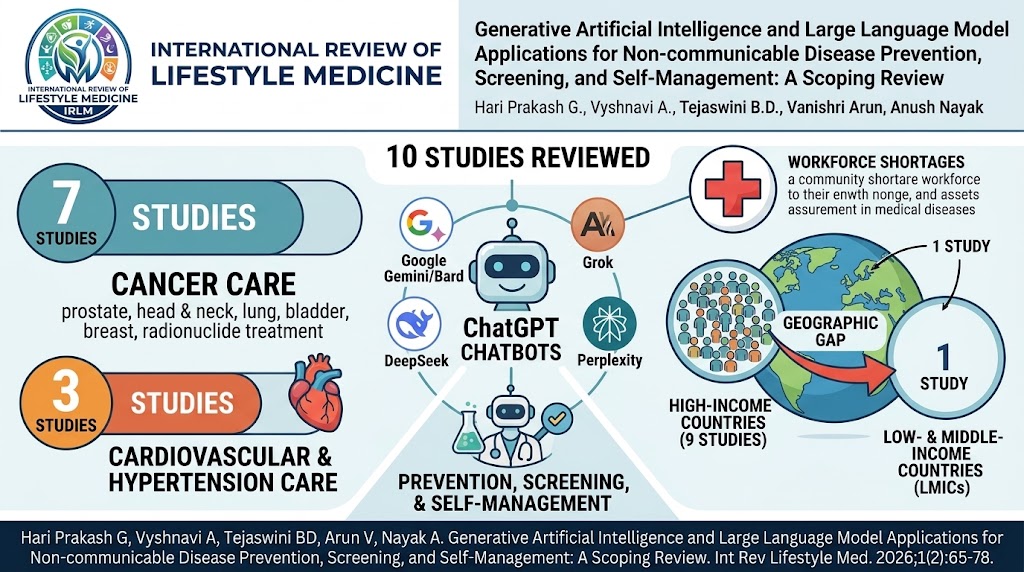
Results: 821 records were identified, of which 10 met the inclusion criteria. Cancer was the domain addressed most often (7/10), followed by cardiovascular disease and hypertension (3/10). Proprietary conversational tools, and most commonly ChatGPT, were evaluated and compared against other chatbots rather than against clinical standards. Accuracy and readability differed from study to study. One study was set in an LMIC; the rest were based in high-income settings or not in a specific country.
Conclusion: Evidence on generative AI/LLM applications for NCD-related patient information is still concentrated in high-income settings. Locally grounded research in LMICs is needed to test their effectiveness and contextual relevance and to guide responsible use in NCD prevention.
Graphical Abstract
Keywords
Subjects
 International Review of Lifestyle Medicine