Document Type : Narrative review
Authors
1
Republican Cancer Center, Tashkent, Uzbekistan
2
Department of Environmental Health Engineering, School of Public Health, Iran University of Medical Sciences, Tehran, Iran
3
Iran University of Medical Sciences, Tehran, Iran
Abstract
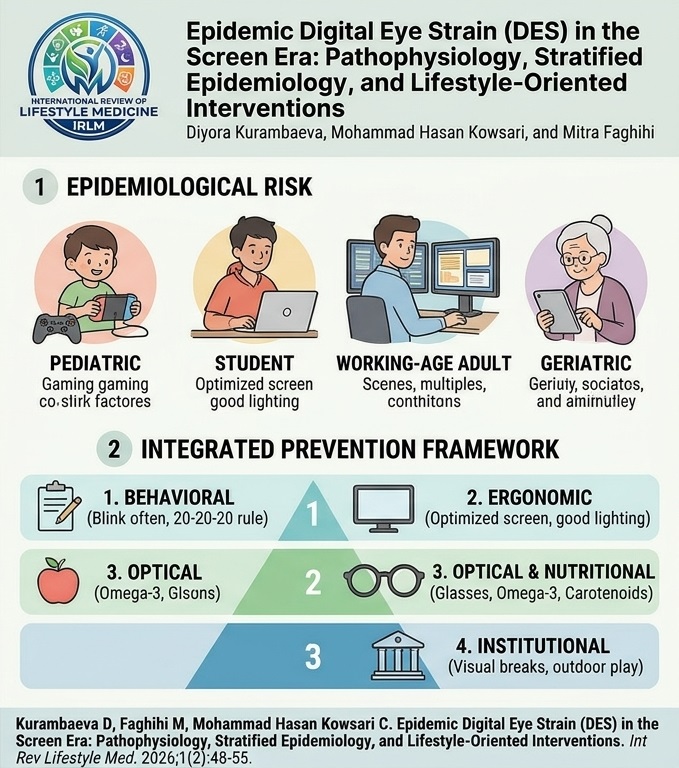
Background and Objective: Digital eye strain (DES), or computer vision syndrome, is a significant public health and occupational concern in the digital era. Prolonged screen exposure disrupts ocular surface homeostasis and accommodative function, increasing visual discomfort. This critical review examines the underlying pathophysiological mechanisms, classifies DES phenotypes, identifies epidemiological and behavioral risk factors, and proposes an integrated, lifestyle-oriented prevention framework.
Methods: A critical scoping review was conducted to synthesize the contemporary pathophysiological framework, epidemiological stratifications, and clinical-ergonomic-behavioral paradigms of DES. We examined the literature on screen-exposure-induced blink dynamics, tear film biochemistry, accommodative strain, and corresponding pediatric, academic, and occupational risks.
Results: Digital eye strain is an important public health and occupational concern associated with prolonged screen exposure. Sustained digital device use may impair ocular surface stability and accommodative function, resulting in visual discomfort. This critical review explores the pathophysiological mechanisms underlying DES, characterizes its clinical phenotypes, identifies key epidemiological and behavioral risk factors, and proposes an integrated lifestyle-based prevention framework.
Conclusion: DES is a direct consequence of a mismatch between evolutionary human visual biology and digital exposures. Effective mitigation requires a multi-layered prevention model combining behavioral blink-awareness training, ergonomic screen-distance optimization, structural visual breaks (e.g., the 20-20-20 rule), refractive optimization, sleep hygiene, and institutional policies. Addressing DES within a lifestyle medicine framework is essential to preserve long-term visual health, productivity, and quality of life in the screen era.
Graphical Abstract
Keywords
Subjects
 International Review of Lifestyle Medicine